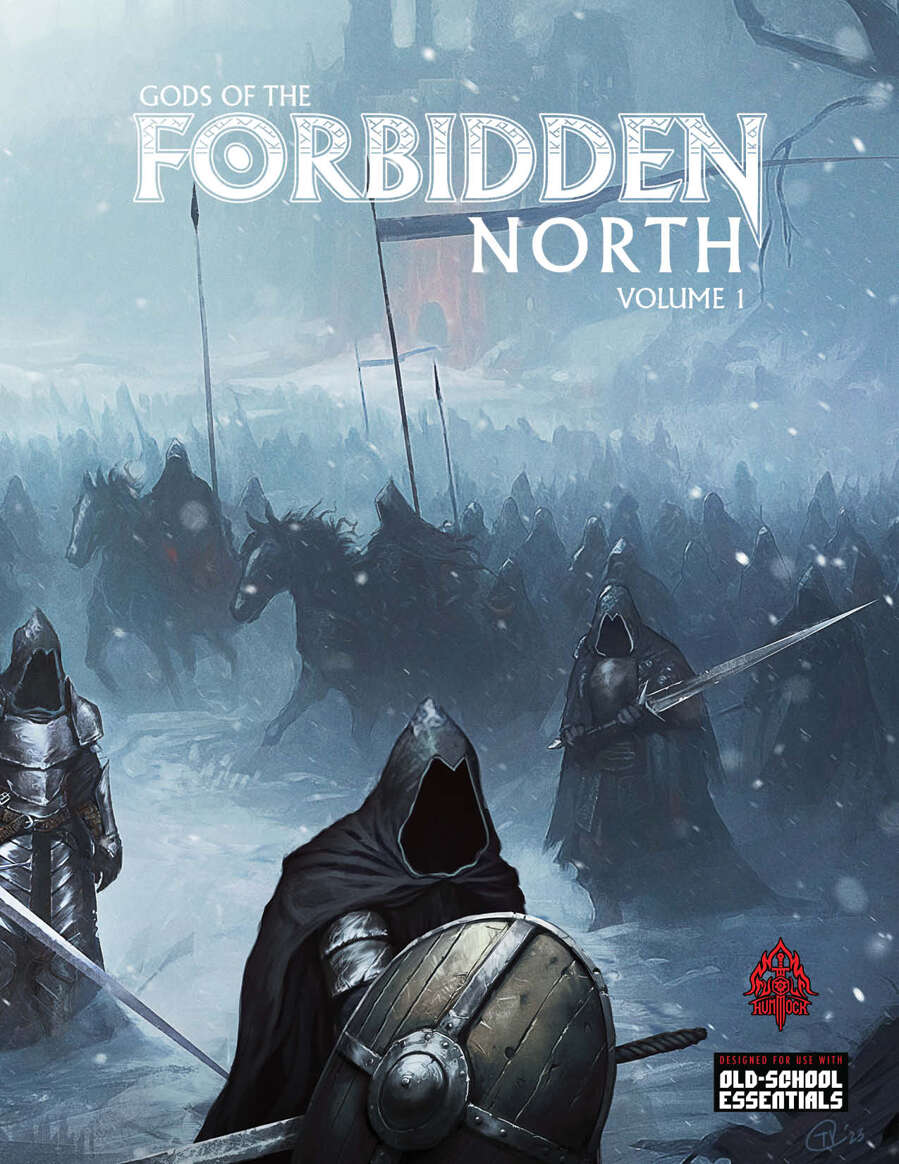
Gods of the Forbidden North, Vol. 1 (OSE Adapted for Shadowdark) – Pulp Hammock Press – Part 1
Overview
I’ve ran parts of Forbidden North in my personal Frozen North Shadowdark campaign.
Book 1 includes roughly 250 pages of urban details, minute details of shops, inns, local politics, cults, a 20-page treatise on one specific cult’s initiation rituals. This was borderline worthless to me personally because I run by the West Marches maxim “the adventure is in the wilderness, not the town” (see Ars Ludi by Lame Mage’s blog, https://arsludi.lamemage.com/index.php/94/west-marches-running-your-own/).
I probably won’t use Book 2, and definitely won’t be using Book 3. Book 1 provides plenty of material for my weekly campaign, but I’m incorporating other content, so it’s not just Forbidden North.
Pros
Not hard to adapt to Shadowdark or an open table.
Forbidden North is playable. There’s a breadth of on-theme encounters and dungeons. Wilderness, tomb, cave, crypt, temple, there’s a lot of variety.
There’s a variety of combat and non-combat options, like the nymph and werebear’s potential wedding. These moments are counterweighted so a party intent on murder will encounter steep difficulties, without it being a gotcha moment (thinking of Village of Hommlet where the innkeep is really a L9 fighter with 18/00 STR or whatever was going on there).
I enjoyed the long-reaching impact of events and the implied continuity: when my players activated the Tomb of the Nine’s gemstone trap and woke all the draugr in one swoop, they fled. As noted in the book, these draugr disperse to serve their demonic masters, seeding them throughout the landscape. When the party returned to the tomb, it was relatively undefended and easily plundered. They encountered one of the draugr near a set of standing stones, a consequence of their exploration.
Consequences from story events segued nicely into ongoing campaign goals.
Shadowdark continues to be a superior RPG for flexibility, and less lethal than OSE.
I printed the maps, and appreciated the player-facing maps immensely. They make prep quick and easy.
Cons
Forbidden North is hard to read. Robert Alderman needs to work on his writing. Multiple times, across multiple dungeons, I struggled to make sense of what features were present in which part of each room – not because the concepts were tough/difficult, but because there was so much cruft and needless details/backstory that I couldn’t sort out what was actually happening.
Clarity is lacking. For example, in Morkaal’s Tomb (the level 1 adventure for OSE), there’s a golem, an amulet, a door with a flesh arm, a gas trap, scores of undead monks, runic traps, a waterfall, more traps, hidden compartments, and a cliff. There’s a whole lot of good stuff going on, but the way it all interacts gets muddled up with all these historical footnotes and tangents, leading to a subpar GM experience at the table.
Forbidden North is in love with itself. It’s good, and has design moments of near-brilliance, but Book 1 could easily be edited down to 250 pages.
Naming gets fuzzy. Baalor the evil warlord gets super-confused with Balor the evil demon. Skaal the town gets confused with Skull the human body part. There’s multiple layers of ancient evil, my players can barely keep track of one level of ancient evil. That’s ultimately a design choice: depth, breadth, both, or neither. Alderman went for “both” on this.

 Dubious Heroes
Leave a comment